Language Learning Apps for Couples: What Each One Does and Who It Suits
A structured feature table of apps couples can use to learn a language together, covering shared vocabulary, live translation, cooperative goals and streaks, with a clear note that LinguaPair is this publisher's own product.

Very few language apps are designed for two people. Most treat learning as a solo activity with a leaderboard bolted on, and couples end up running two separate accounts that never touch. This comparison looks at what each widely used app actually offers a pair, whether that is a shared vocabulary list, a live translator for conversations between you, cooperative goals, or simply a way to keep each other going.
A disclosure first: LinguaPair, one of the apps below, is made by the company that publishes this site. We describe it with the same criteria as the others, and we list its limitations alongside its features.
Which features matter for a couple
Before the table, the four features worth checking, because they decide whether an app works for two people or merely tolerates them.
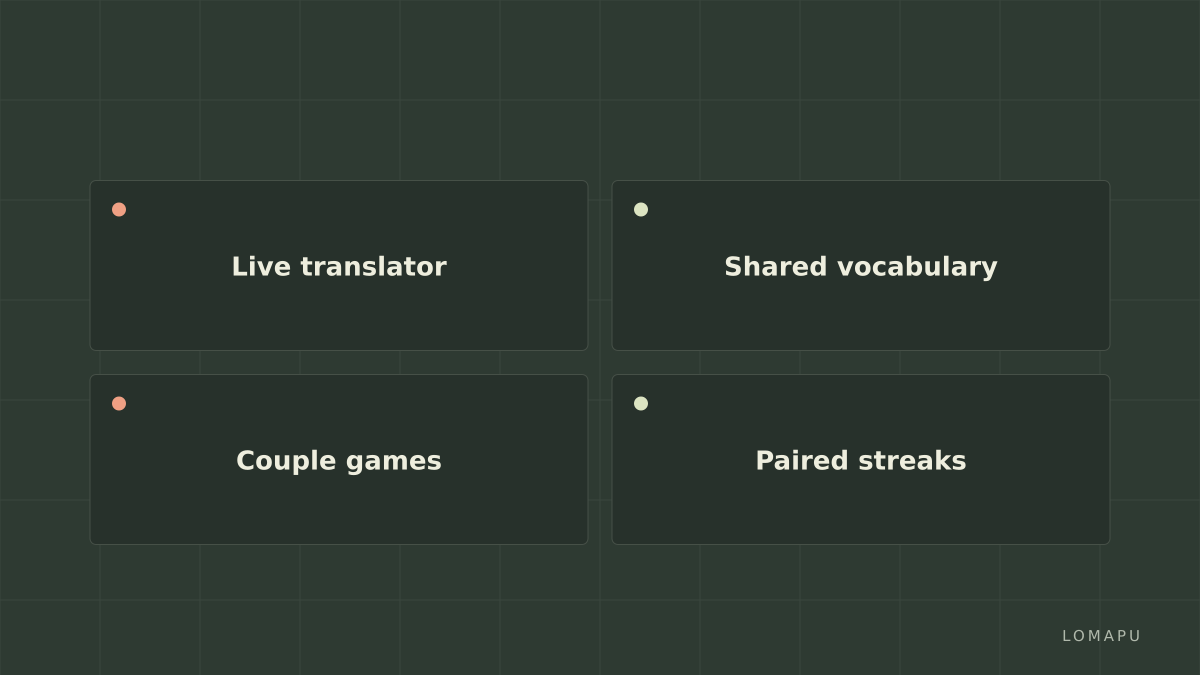
Live translator. For couples who do not yet share the language, the ability to speak in your own languages and see both sides translated. Turns dinner conversation into learning material.
Shared vocabulary. One word list both partners add to and review, so the vocabulary comes from your life together rather than from a preset course.
Cooperative games or goals. Challenges you complete together rather than against each other. Competition between partners is fun for some couples and corrosive for others.
Paired streaks. Accountability that notices when either of you stops, without ranking you against each other.
The comparison table
App | Built for couples | Live translator | Shared vocabulary | Cooperative goals | Streaks | Free tier | Best suited to |
|---|---|---|---|---|---|---|---|
LinguaPair (our product) | Yes | Yes, voice to text to translation, one or two devices | Yes, extracted and graded from your conversations | Yes, duels and races from the shared list | Paired streaks and leagues | Yes: ten minutes of translator a day, beginner levels, a hundred words, at the time of checking | Couples where one partner is learning the other's language, or both learning together |
Duolingo | No, but has friend features | No | No | Friends Quests: weekly shared challenges with a friend | Individual streaks | Yes, with a paid tier | Couples who already use it separately and want one shared goal a week |
Tandem | No; built for strangers | Translation and correction tools inside chat | No | No | No | Yes, with a Pro tier | Getting conversation practice from native speakers outside the relationship |
HelloTalk | No; built for strangers | Translation, transliteration and correction inside chat | No | No | No | Yes, with a VIP tier | Same as Tandem, with group voice rooms and a social feed |
Anki | No | No | Decks can be exported and shared; each person reviews alone | No | No | Free on desktop and Android; paid official iOS app | Couples who want one shared word list with independent review speeds |
Cells reflect what each service describes on its own pages at the time of checking; features and tiers change, so verify on the app's site before you rely on one.
App by app
LinguaPair
The only app in this list that assumes two users from the start. Its core is a live translator: you talk in your own languages, on one device or two, and the app produces text and translation in real time. Words from those sessions are extracted and graded into a shared vocabulary, which then feeds lessons, speed-translation duels and vocabulary races. Progress is paired, with individual streaks and shared XP. Courses run from complete beginner to advanced across seven languages: English, Russian, Spanish, Vietnamese, Japanese, Korean and French. It runs on iPhone, Android and the web.
The free tier, according to the site at the time of checking, includes ten minutes of translator a day, the beginner levels and storage for a hundred words. The paid tier is one subscription that covers both partners.
Limitations: seven languages means many couples are simply out of scope. The translator can become a crutch if you use it at every meal instead of struggling through. And because it is built around a pair, it offers little to someone learning alone. If you match the profile, try the free tier as a pair for two weeks before deciding.
Duolingo
Not a couples app, but its Friends Quests are the one mainstream cooperative feature worth noting. According to Duolingo's announcement, you are paired automatically each week with a friend you follow mutually, given a shared challenge such as earning a set amount of XP, and rewarded together on completion. Pairing is random among your friends rather than chosen, so if you only follow each other, you get each other. There is no shared vocabulary and no translator; you each follow your own course.
Suits couples who already like Duolingo's format and want one joint target a week without changing tools.
Tandem and HelloTalk
Both are language exchange communities: you find native speakers of your target language who want to learn yours, and practise by text, voice and video with built-in correction and translation. Neither is designed for two people in a relationship; their value to a couple is indirect. A partner learning the other's language gets conversation practice with someone who is not their partner, which removes emotional pressure and adds a second voice and accent. HelloTalk adds group voice rooms and a social feed; Tandem emphasises one-to-one matching with filters.
Suits couples where one partner needs more speaking practice than the other can patiently provide.
Anki
A free, open-source spaced-repetition flashcard program. It has no couple features, but it does the shared-vocabulary job well in a different way: one partner builds a deck, exports it, and both review their own copy at their own pace. Because scheduling is per user, the faster learner is never held back and the slower one never feels rushed. Desktop and Android versions are free; the official iOS app is a paid purchase that funds development.
Suits couples who want a shared word list and independent review, and who do not mind assembling material themselves.
Choosing by scenario
Your situation | Start with | Add later |
|---|---|---|
One of you is learning the other's native language | LinguaPair for the translator and shared words | Tandem or HelloTalk for practice outside the relationship |
Both learning a third language from zero | A structured course app each, plus a shared Anki deck | LinguaPair for cooperative games once you have some words |
You already use Duolingo daily | Follow each other and use Friends Quests | A shared word list in Anki or LinguaPair for real-life vocabulary |
One partner is far ahead | Anki shared deck with independent review | Exchange app for the partner who needs more speaking |
Budget is zero | Anki plus an exchange app | LinguaPair's free tier if you are within its seven languages |
Summary
For a couple that wants to learn together, rather than side by side, the app has to know there are two of you. In this set only LinguaPair does, which is why it heads the table and why we have said openly that it is ours; its seven-language limit and the temptation to over-use the translator are the honest caveats. Duolingo's Friends Quests give existing users a light cooperative layer. Tandem and HelloTalk supply practice partners outside the relationship. Anki quietly solves the shared-vocabulary problem for couples who move at different speeds. Check each app's current terms and availability on its own site, and if you fit LinguaPair's profile, start with the free tier together and let two weeks of use decide.