How Long Does It Take to Learn Spanish? Hour Estimates by Level and Weekly Schedule
Published hour estimates from the US Foreign Service Institute and Cambridge English, converted into calendar timelines for 3, 5 and 10 hours a week, with a table for each CEFR level and the caveats behind every number.
Nobody can promise you a date by which you will "speak Spanish", but two institutions have published hour estimates that let you build a realistic calendar. This article takes those numbers as they are, converts them into weeks and months for three common weekly schedules, and shows where the estimates stop being useful. The goal is a plan you can put in a diary, not a motivational slogan.
The two published estimates
US Foreign Service Institute (FSI). The State Department's language school groups languages by how long its diplomats typically need to reach Professional Working Proficiency (a 3 on the Interagency Language Roundtable scale for speaking and reading). Spanish sits in Category I, the group closest to English, with an estimate of 24 to 30 weeks, or 600 to 750 class hours. Two conditions matter: FSI students study more or less full time, and the target is a professional level, well beyond holiday conversation. FSI itself notes that real times vary with aptitude, prior languages and time in class.
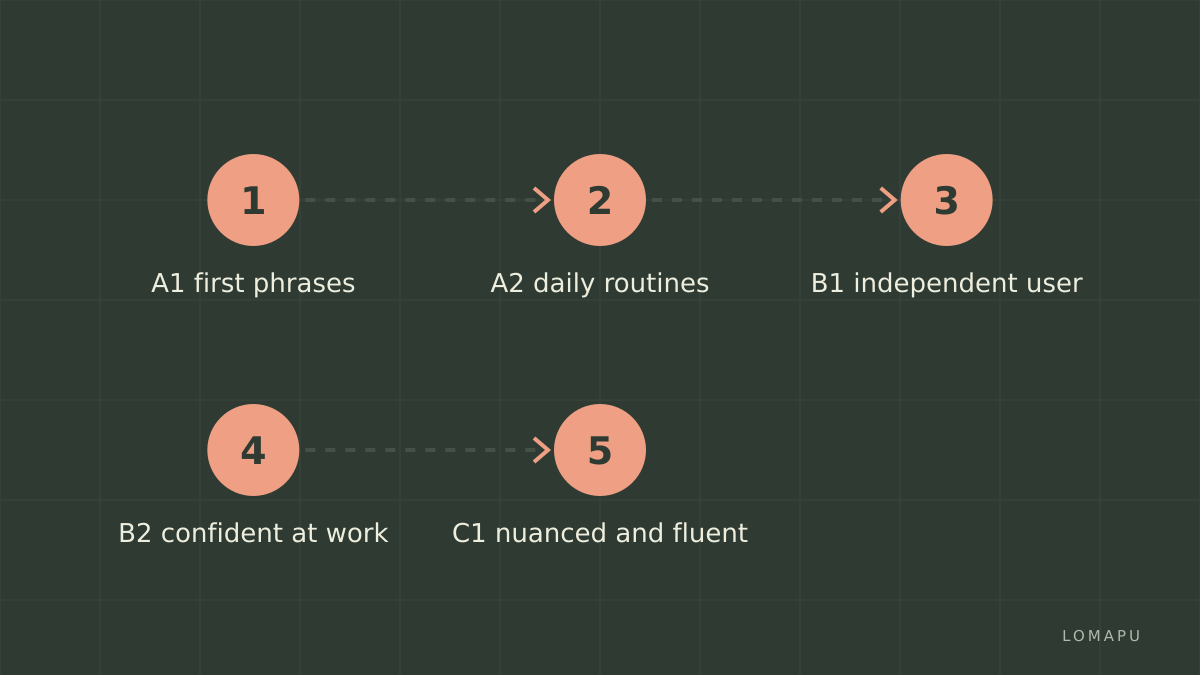
Cambridge English guided learning hours. Cambridge publishes cumulative guided learning hours needed to reach each CEFR level: roughly 180 to 200 hours for A2, 350 to 400 for B1, 500 to 600 for B2, 700 to 800 for C1 and 1,000 to 1,200 for C2. "Guided" means class time plus homework set by a teacher, and the figures are cumulative from zero. Cambridge published them for English learners, so for Spanish they are a proxy; the two languages are of comparable difficulty for each other's speakers, which is why the FSI places Spanish in its easiest category.
Put side by side, the two sources agree surprisingly well: the FSI's 600 to 750 hours to professional proficiency overlaps Cambridge's 500 to 800 hours for B2 to C1. That overlap is the most useful fact in this article. It means you can plan with a single range and stop hunting for a magic method that promises fluency in three months.
From hours to calendar: three schedules
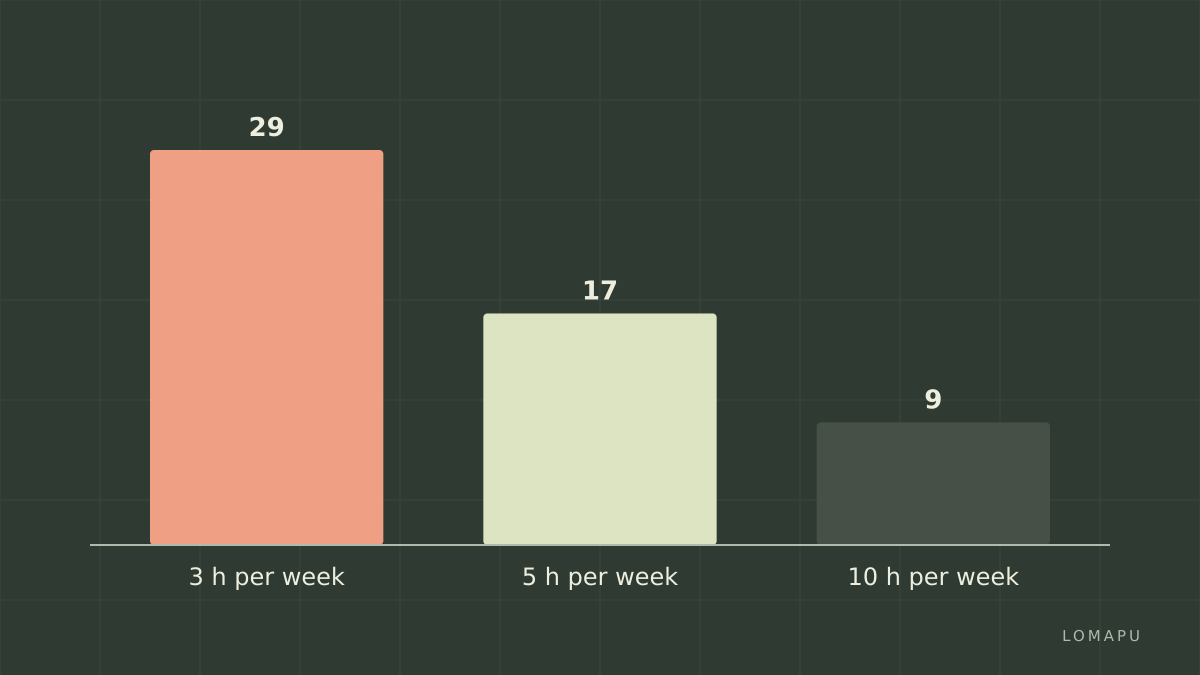
Divide the cumulative hours by your realistic weekly hours and you get weeks. The table below uses Cambridge's cumulative figures and rounds to whole months (one month taken as 4.3 weeks). All hours are guided study, so an hour of passive podcast listening does not count fully.
Target level | Cumulative hours | 3 hours a week | 5 hours a week | 10 hours a week |
|---|---|---|---|---|
A2 | 180–200 | 14–16 months | 8–9 months | 4–5 months |
B1 | 350–400 | 27–31 months | 16–19 months | 8–9 months |
B2 | 500–600 | 3.2–3.9 years | 23–28 months | 12–14 months |
C1 | 700–800 | 4.5–5.2 years | 2.7–3.1 years | 16–19 months |
FSI Professional (ILR 3) | 600–750 | 3.8–4.8 years | 2.3–2.9 years | 14–18 months |
Two patterns fall out of the arithmetic:
Three hours a week gets you to A2 in about a year and to B1 in two to three years. That is a respectable outcome for a hobby, but if you want to hold a real conversation within twelve months, three hours is not enough.
Doubling weekly hours roughly halves the calendar, with no penalty. There is a modest bonus for intensity, because you forget less between sessions, but the sources do not quantify it, and neither should you.
Which schedule fits which life
Rather than asking "how long does Spanish take", ask which row of the table you can sustain for the whole duration. A schedule you abandon after eight weeks has an effective speed of zero.
Your situation | Realistic weekly hours | First milestone | Watch out for |
|---|---|---|---|
Full-time job, family, commute | 3 (three 1-hour blocks) | A2 in 14–16 months | Long gaps; forgetting outpaces learning below 2 hours |
Job with flexible evenings | 5 (five 1-hour blocks or three 100-minute blocks) | B1 in 16–19 months | Skipping speaking because it is the hardest hour to schedule |
Student, sabbatical, remote worker | 10 (2 hours on weekdays) | B2 in 12–14 months | Burnout in month three; plan a lighter week every fifth week |
Moving to a Spanish-speaking country | 10 plus immersion | B1 in 6–9 months | Immersion hours count only if you engage; ambient noise is not study |
The decision is less about ambition than about the smallest number you can guarantee on a bad week. Choose the row where the weekly figure is your floor, not your ceiling.
What the estimates leave out
Hour tables measure guided study for a generic adult. Several factors move you up or down within a range, and they are worth naming so you can adjust honestly:
Prior Romance language. French, Italian or Portuguese speakers recognise much of Spanish vocabulary and grammar. Expect to sit at the low end of each range, or below it.
Definition of "learned". A2 lets you order, shop and describe your day. B1 makes you an independent user who can handle travel and simple work topics. B2 is where colleagues stop simplifying their speech for you. Decide which one you mean before you compare timelines with anyone else.
Quality of the hours. An hour with a tutor who corrects you and an hour reading subtitles are not equal. The Cambridge figures assume a teacher setting homework; self-taught learners typically need more total hours, though no source gives a multiplier.
Skills are uneven. Reading in Spanish outruns speaking for most English speakers because of shared Latin vocabulary. Your listening may be A2 while your reading tests at B1; the timeline for "conversation" follows the weakest skill.
Dialect and register. The estimates describe general proficiency. Adapting to Rioplatense Spanish or to legal vocabulary is extra time on top, usually weeks rather than months.
How to use the numbers without being fooled by them
Pick the level, not the year. Write down A2, B1 or B2 and what you want to do at that level.
Choose your floor. Decide the weekly hours you can keep on your worst week, then read your calendar date from the table.
Count only guided hours. Log tutoring, class, coursework and homework. Log passive exposure separately and do not let it inflate the total.
Test at each rung. Free placement tests and official DELE or SIELE exams give you an external check; if your logged hours say B1 but a test says A2, the hours were not all guided.
Re-plan every quarter. Compare logged hours to the table and move your target date rather than your target level.
Conclusion
The honest answer to "how long does it take to learn Spanish" is a range that depends on two numbers you control: the level you are aiming at and the weekly hours you can sustain. Published estimates put conversational independence (B1) at roughly 350 to 400 guided hours and professional proficiency at 600 to 800, which means about a year and a half at five hours a week for B1, and one to one and a half years of near full-time study for the professional level. Anything faster than that is either a smaller definition of "learned", a head start from another Romance language, or a promise without a source. Pick your row, protect your floor, and let the calendar follow.